There’s a particular kind of confidence that shows up right before someone gets hurt: “it’s just a needle, I’ll grab a bag and pick it up.” It’s an understandable instinct. A discarded needle looks like litter, and most litter doesn’t need a specialist. But a used sharp isn’t ordinary litter, and the gap between how simple the task looks and how much can go wrong if it’s handled badly is exactly why this guide exists.
This article looks honestly at the real health risks involved, separates them from the exaggerated fears that sometimes surround this topic, and explains precisely why a proper, trained approach matters, even for something that takes thirty seconds to do badly and considerably longer to do properly.
If you haven’t read it already, our complete guide to needle sweeps covers the responsibility and legal side of this topic in more depth.
What’s actually at risk: bloodborne viruses
The core danger from a used needle isn’t the puncture wound itself, which is usually minor, but what might be on the needle when it breaks the skin. The bloodborne viruses of greatest concern are Hepatitis B, Hepatitis C and HIV, all of which can, in the right circumstances, be transmitted through contaminated blood entering the body via a break in the skin.
Government guidance on drug-related litter notes that discarded needles can carry active Hepatitis B or C at rates of up to 10%, a figure worth sitting with for a moment. It doesn’t mean one in ten needle-stick injuries results in infection; transmission depends on several further factors, including how much blood is involved, how deep the injury is, and how long the virus has survived outside the body. But it does mean that treating every found needle as though it could be contaminated isn’t paranoia, it’s the only sensible starting assumption, because there’s no way to tell by looking at it.
How the risk compares in a clinical context
To put the numbers in perspective, in a clinical setting where the source of a sharp is known to be infected, published transmission risk from a single percutaneous injury is estimated at around 30% for Hepatitis B, 3% for Hepatitis C and 0.3% for HIV. Those figures apply to a known-positive source, which is a very different scenario to a needle found in a park, where the source and its infection status are almost always unknown. The uncertainty is precisely the point: without knowing where a needle has been, the only responsible approach is to treat every one as though the worst-case scenario applies, however statistically unlikely that actually is.
Why the psychological impact matters too
The physical risk from a single needle-stick injury is genuinely low in most cases, but the anxiety that follows one is very real, and it shouldn’t be dismissed as an overreaction. Anyone who’s been stuck by a needle of unknown origin typically faces a waiting period for test results, sometimes alongside a course of post-exposure medication with its own side effects, all while not knowing whether they’ve been exposed to a serious illness. This period of uncertainty can be genuinely distressing, and it’s one of the strongest arguments for prevention over cure: avoiding the injury in the first place, through proper training, PPE and technique, avoids the anxiety and disruption that follows one entirely, not just the small statistical chance of actual infection.
For organisations with staff who might encounter sharps, it’s worth factoring this into how an incident is handled internally. A member of staff who’s had a needle-stick injury needs prompt medical attention, but they also need to feel supported and taken seriously by their employer, rather than made to feel they overreacted to something “minor”. Good incident response covers both.
It’s not only bloodborne viruses
Bloodborne viruses get most of the attention, understandably, but they’re not the only health risk associated with a needle-stick injury or discarded drug litter more broadly. Tetanus is a real consideration for any puncture wound from an item that’s been outdoors or in contact with soil, which is precisely the environment many discarded needles are found in. Anyone with an out-of-date tetanus vaccination who’s injured this way should mention it when seeking medical advice, since a booster may be recommended alongside any bloodborne virus assessment.
Secondary bacterial infection at the wound site is another possibility, unrelated to what was in the needle itself, simply because any puncture wound carries some infection risk if it isn’t cleaned and monitored properly. And drug litter is rarely just needles: broken glass, discarded blades, and citric acid sachets used in drug preparation can all cause injury or skin irritation in their own right, which is part of why a genuine sweep treats the whole area as a hazard zone, rather than searching only for syringes specifically.
Why perceived risk and actual risk diverge
Government guidance on drug-related litter is candid about this gap: the actual health risk to the general public from drug litter is genuinely very small, but the perceived risk is considerable, and that perception has real consequences of its own. Areas with a visible needle problem see people avoid parks, playgrounds and public spaces altogether, which affects wellbeing and community life in ways that have nothing to do with the statistical chance of infection. This isn’t a reason to dismiss the perceived risk as irrational; it’s a reason to take the presence of drug litter seriously as a public confidence issue, separately from the direct medical risk, and to recognise that a fast, visible, professional response does double duty: it removes the actual hazard, and it reassures a community or workforce that the hazard has genuinely been dealt with, not just hidden.
This is also why professional providers document sweeps as thoroughly as they do. A clearance report that says “the site has been searched and confirmed clear” carries reassurance value for staff, tenants, parents or the public that goes beyond its legal and insurance purpose, precisely because it answers the question people are actually anxious about: is it definitely gone now, all of it, not just the one we saw?
If someone is stuck by a needle: the correct response
Speed and the right steps matter more than panic or delay. Anyone injured by a sharp that may be contaminated should:
- Encourage the wound to bleed gently, ideally holding it under running water
- Wash the area thoroughly with running water and plenty of soap, without scrubbing the wound
- Avoid sucking the wound
- Cover it with a waterproof plaster or dressing
- Seek urgent medical advice as soon as possible, ideally from an A&E department or occupational health service, since post-exposure treatment is time-sensitive and considerably more effective when started quickly
- Note the time, date, location and circumstances of the injury, along with any details about the needle itself, for reporting and medical purposes
If the injury happened at work, it should be reported through the organisation’s normal incident process, and, depending on the circumstances, may need to be reported to the Health and Safety Executive under RIDDOR (the Reporting of Injuries, Diseases and Dangerous Occurrences Regulations 2013), particularly where the sharp is known to be contaminated or the injury is serious enough to keep someone off work for more than seven days.
Why timing matters so much after an injury
One detail that gets lost in the immediate panic of a needle-stick injury is how much timing affects the medical options available afterwards. Post-exposure treatment for certain bloodborne viruses, where appropriate, is most effective when started as soon as possible, and its usefulness diminishes sharply the longer someone waits, with medical guidance generally treating anything beyond 72 hours as too late for some preventative treatments to be worthwhile. This is precisely why “seek urgent medical advice” isn’t just a standard caution to include in a guide like this one; it’s a genuinely time-sensitive instruction that changes real outcomes. Someone who waits a few days to “see if anything happens” before getting checked has, in some cases, already missed the window where medical intervention could have made the most difference. Whatever the circumstances of the injury, treating it as urgent rather than a wait-and-see situation gives the person involved the best possible range of options.
If it happened in someone else’s care
Where a needle-stick injury happens to a member of staff, a tenant, a pupil or a visitor on a site you’re responsible for, your organisation’s response matters almost as much as the individual’s own actions. A clear, written procedure should specify who’s told immediately, how the person is supported in getting urgent medical attention, how the incident is documented (including details of the needle if safe to record, such as its location and condition), and how it’s reported internally and, where applicable, to the Health and Safety Executive under RIDDOR. Organisations that only think through this process after an injury has already happened tend to handle it worse, through nobody’s fault other than the pressure of dealing with something serious and unfamiliar in real time. A five-minute written procedure, agreed and shared in advance, removes most of that pressure when it’s actually needed.
Why a “quick look” isn’t the same as a proper sweep
This is where most DIY attempts fall down, not through carelessness exactly, but through a mismatch between what people think a needle sweep involves and what it actually requires. A quick visual scan of an obviously affected area catches the needle you already know about. It very rarely catches the ones you don’t, and drug use rarely involves just one item left in one place.
Needles get kicked into long grass, dropped through drain covers, tucked behind bins for later, pushed into gaps in fencing, or left under benches, decking or play equipment where they’re genuinely hard to spot without deliberately checking. A professional sweep is systematic precisely because informal searches consistently miss items in these locations. This isn’t a criticism of anyone’s thoroughness; it’s simply what happens when a search isn’t structured, however careful the person doing it feels they’re being. A grid-based approach, covering a site in defined, overlapping sections, exists specifically to counter the natural human tendency to check the obvious spots and assume the rest is clear.
The equipment gap
Even a careful, well-intentioned DIY attempt is usually working with the wrong tools. Bare or lightly gloved hands offer no meaningful puncture protection against a needle, which is designed, after all, to penetrate skin with minimal resistance. Standard household gloves, including thick gardening gloves, are not puncture-resistant to a clinical standard, and a surprising number of injuries happen precisely because someone felt protected by gloves that weren’t actually designed for this purpose.
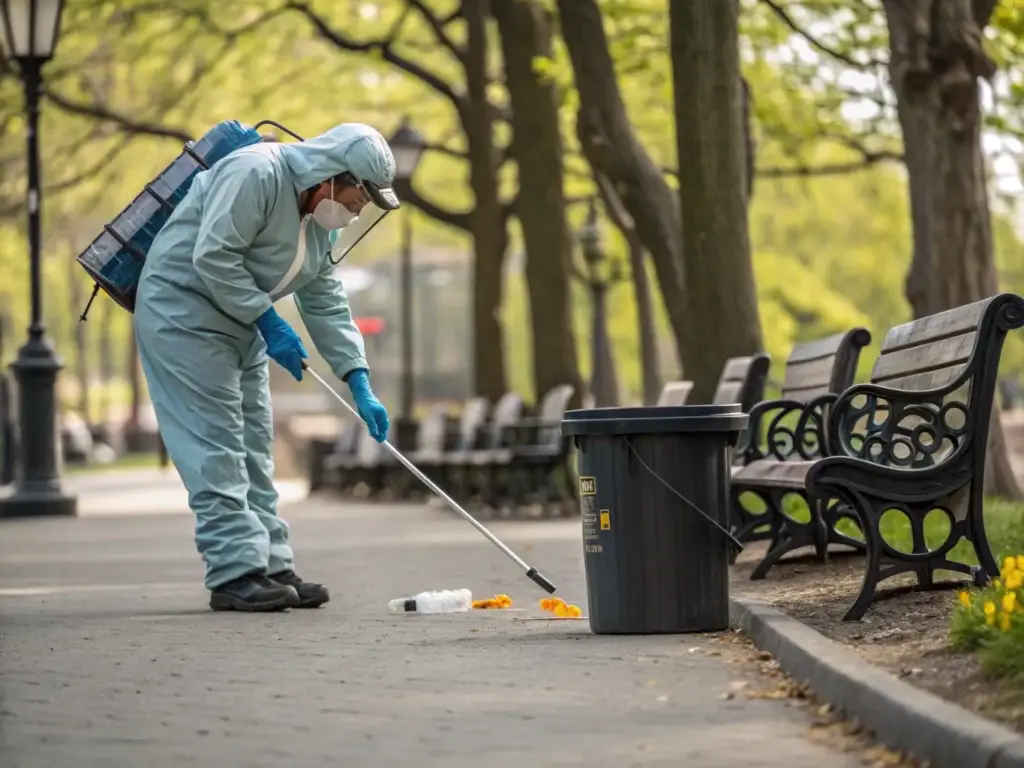
Picking a needle up by hand, even with tongs or a stick improvised for the purpose, also increases the risk of an accidental jab compared to using tools designed for the task, such as proper long-handled forceps that keep the hand a safe distance from the point. And once a needle is collected, where does it go? A carrier bag, a jam jar, or a cardboard box are not puncture-proof, which means the risk doesn’t end when the item is picked up; it simply moves to whoever handles that bag or box next, whether that’s the person carrying it to a bin, a waste collector, or, worst of all, a child who finds it later. Proper sharps containers, built and tested to British Standard BS 7320, are rigid, puncture-resistant and designed specifically to contain sharps safely from the point of collection through to disposal.
The disposal gap
Even where a needle is safely collected, what happens next is where a lot of DIY attempts unknowingly create a second hazard. Needles placed in general waste bins can injure waste collection staff, who have no reason to expect a sharp in household or commercial rubbish and handle it accordingly. This isn’t a hypothetical risk; it’s a recognised occupational hazard for the waste and recycling sector, and it’s precisely why used needles are legally classed as clinical and hazardous waste rather than general litter, requiring collection by a carrier specifically authorised to handle it, under the Hazardous Waste (England and Wales) Regulations 2005.
Simply binning a found needle, however well-intentioned the removal itself was, doesn’t resolve the hazard; it relocates it to someone with even less warning and even less protective equipment than the person who found it originally.
What professional technicians are trained to do differently
None of this is about competence or intelligence; it’s about training, equipment and process that most people, understandably, have never needed to learn. Professional needle sweep technicians are trained specifically in:
Risk assessment before starting. Understanding the type of site, likely hotspots based on layout and reporting history, and any additional hazards before beginning the search.
Correct PPE selection and use. Puncture-resistant gloves tested to the appropriate standard, and additional protective clothing where the site or level of contamination warrants it.
Systematic search technique. Covering ground in a structured, grid-based pattern rather than a visual scan, specifically to catch the items that aren’t immediately obvious.
Safe handling technique. Using proper tools, such as forceps or tongs, to keep hands away from the point of a sharp at every stage, and never re-sheathing, re-capping or otherwise manipulating a used needle by hand.
Correct containment. Placing every item directly into a compliant sharps container, never into a bag, box or pocket, even temporarily.
Compliant disposal. Passing collected sharps to a licensed hazardous waste carrier, with a proper consignment note completed, so the waste is tracked and destroyed correctly rather than ending up in a general waste stream.
Incident response readiness. Knowing exactly what to do, and who to inform, in the rare event that a needle-stick injury does occur on the job, without the delay or uncertainty of trying to work it out in the moment.
This is, genuinely, a learnable skill set. It’s also one that most organisations don’t need often enough to justify building and maintaining it in-house, which is exactly why specialist providers exist, and why bringing one in for anything beyond the most minor, single-item find tends to be the safer, and ultimately cheaper, choice once the risk of getting it wrong is properly accounted for.
Special considerations for vulnerable groups
Some settings carry extra weight when weighing up the risk of a DIY response. Schools, nurseries and any site used by children need a higher standard of care, not because the statistical risk to a child is different, but because children are less able to recognise a hazard, more likely to pick something up out of curiosity, and less able to follow the correct first-aid steps if something does happen. Care homes, supported housing and other settings with vulnerable adults carry similar considerations, particularly where residents may have limited mobility, cognitive impairment, or difficulty reporting an incident promptly. In these environments, even a single reported needle warrants a full, professional sweep of the surrounding area, rather than an assumption that one item found means one item present. Where a site of this type has any history of drug litter, however minor or long ago, it’s worth treating that history as a standing reason to check more thoroughly than usual, rather than a closed chapter that’s unlikely to recur.
Reducing the chance of an injury happening at all
Beyond training and correct technique, physical prevention measures make a genuine difference to how often anyone, staff or public, ends up close enough to a needle to be at risk in the first place. Dedicated sharps disposal bins in public toilets and known hotspot areas give people who use drugs a safer place to dispose of equipment than leaving it where it was used, and sites that install them alongside regular sweeps tend to see fewer stray items over time. Improved lighting in secluded corners, stairwells and car parks reduces the seclusion that makes a spot attractive for injecting drug use in the first place, and cutting back dense vegetation removes the concealment that lets needles go unnoticed for weeks. None of these measures eliminate the need for sweeps entirely, but organisations that combine sensible prevention with a proper response process consistently report fewer incidents than those relying on clean-up alone.
Frequently asked questions
How likely am I to actually get infected from a needle-stick injury?
Statistically low in most cases, but not negligible, and impossible to assess accurately in the moment for a needle found in public, since the source and its infection status are unknown. This is exactly why every injury should be treated seriously and reported for proper medical assessment, rather than assessed by guesswork.
Is it safe to remove a single, clearly visible needle myself?
It’s strongly discouraged unless you have proper puncture-resistant gloves, a compliant sharps container, and are confident you’ve checked the surrounding area thoroughly, since a single visible item is often not the only one present. Police forces and councils routinely advise the public not to attempt removal themselves.
What should I do if my child finds a needle?
Keep them away from it immediately without touching it yourself if you’re not properly equipped, and report it to the council if it’s on public land, or to whoever manages the site if it’s private. If your child has been in direct contact with the item, seek medical advice promptly.
Can a needle-stick injury be treated after the fact?
Yes, and speed matters significantly. Post-exposure treatment for certain bloodborne viruses is most effective when started soon after exposure, which is why urgent medical advice, rather than a wait-and-see approach, is always the right call.
Do professional needle sweep technicians ever get injured on the job?
It’s rare, precisely because of the training, equipment and systematic technique involved, but it’s not treated as impossible. Reputable providers have a clear incident response process for their own staff, which is itself a good sign of a properly run operation.
Is the risk different for needles found indoors versus outdoors?
The bloodborne virus risk itself doesn’t change based on location, but indoor sites, particularly void properties, more often involve additional hazards such as bodily fluid contamination or a higher concentration of items, which is another reason a full professional sweep, rather than a quick indoor tidy, is the appropriate response.
Do I need a tetanus booster after a needle-stick injury?
It’s worth mentioning your vaccination history to whoever assesses you medically, since a booster may be recommended alongside any bloodborne virus assessment, particularly if the needle had been outdoors or in contact with soil.
Why do professionals sometimes find more needles than were originally reported?
Because drug use at a given spot is rarely a single, isolated event. Once an area has been used once, it’s often used again, and items from previous visits can remain hidden in vegetation, drains or gaps for some time before being reported or found. A systematic search is designed to catch this pattern, which is exactly why a “we found three, not the one you reported” outcome is common rather than unusual.
Respect the risk, not the fear
The honest position on discarded needles sits between two unhelpful extremes: treating them as a minor inconvenience anyone can deal with in passing, and treating every find as a public health emergency requiring evacuation and panic. Neither reflects reality. The real risk is low but genuine, the consequences of infection are serious enough to take seriously, and the gap between a careful amateur attempt and a properly trained, equipped professional response is exactly where that risk lives. Respecting that gap, rather than assuming good intentions are enough, is what keeps the people doing the removal, and everyone who might encounter that site afterwards, safe. It’s also, in the end, a fairly small ask: a phone call to a trained team costs little in time or money compared to the disruption, worry and genuine health risk of getting this wrong, and it means nobody on your site has to make a judgement call about a hazard they were never trained to assess.
If you need a professional needle sweep carried out safely and compliantly, our fully trained, CHAS accredited team is available across the UK for both emergency call-outs and scheduled visits. Call 0800 002 9086 or visit our needle and sharps sweep service page for a free, no-obligation quote.